Panama’s World Cup Return Was About More Than the Scoreboard
Panama’s return to the FIFA World Cup carried the emotion of a country that has learned to dream bigger with its national team. In Group L, La Sele faced England, Croatia, and Ghana, three opponents with longer football histories, deeper squads, and far more experience on the world stage.
But this World Cup did not feel like 2018. It felt more mature, more competitive, and far more connected to a fan base that has grown with the team.
Panama’s first World Cup in Russia was unforgettable because it marked the country’s arrival. The results were difficult, with three losses, 11 goals conceded, and a minus-nine goal difference, but one moment rose above everything else: Felipe Baloy’s goal against England, Panama’s first World Cup goal, celebrated across the country with the force of a victory.
That tournament was about being there. This one was about showing how much had changed.
Panama opened its 2026 campaign in Toronto with a painful 1-0 loss to Ghana, decided by a late goal in stoppage time. Days later, another 1-0 defeat came against Croatia, a former World Cup finalist and one of Europe’s most respected national teams. That result ended Panama’s hopes of reaching the knockout stage, but it did not erase what the performances revealed.
Panama was not overwhelmed. It was not pushed aside. It stayed in both matches long enough to make them hurt.In 2018, Panama conceded 11 goals in three matches. In its first two games of 2026, it conceded only two. The country is still waiting for its first World Cup point and first World Cup win, but the gap between Panama and the game’s established nations looked smaller than it did eight years ago.
The difference was also visible in the stands. In Russia 2018, around 4,000 Panamanian fans traveled to support the national team. In 2026, that presence multiplied. Local media reported estimates of 20,000 to 25,000 Panamanian supporters in Toronto, including fans who traveled from Panama, Panamanians living in Canada, and supporters who arrived from different cities across the United States.
That means the Marea Roja in Toronto was roughly five times larger than the traveling support seen in Russia. For a country of Panama’s size, that is not just a sports statistic. It is a cultural moment.
Panamanians did not simply attend the World Cup. They carried the country with them. They filled streets with red shirts, flags, drums, music, and emotion. They gathered near stadiums, visited landmarks, marched together, and turned parts of Toronto into an extension of home. Panama’s ambassador in Canada even described the city during the tournament as feeling like a small corregimiento of Panama, with red flags everywhere.
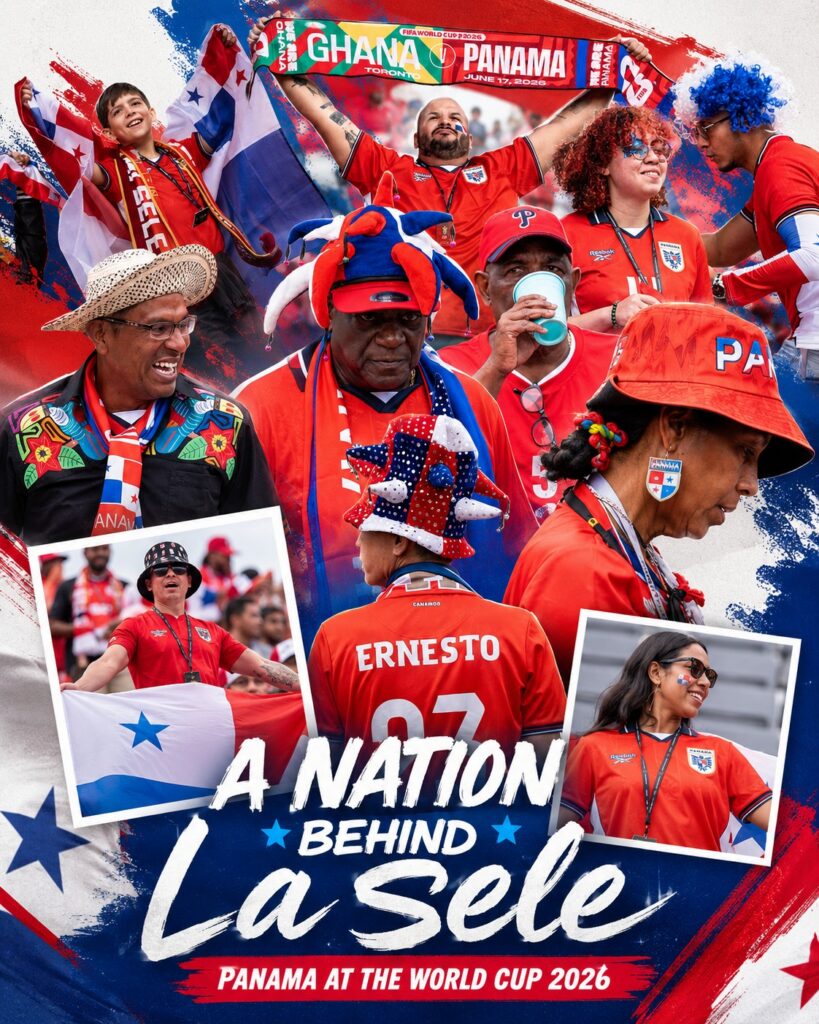
The same thing happened back home. Across Panama, restaurants, plazas, offices, hotels, malls, and public spaces became gathering points to watch La Sele. Brands, communities, and local venues created activations around the matches. People wore red to work, watched together during office hours, and organized around the national team as if the games were national holidays.
That is part of what makes Panama different. This is a country that loves sports, but it has a special relationship with La Sele. The national team is not just followed. It is felt. It gives people a shared language, a shared anxiety, and a shared pride that cuts across age, neighborhood, background, and daily routine.
The numbers at home also showed that connection. Local media, citing FIFA data, reported that Panama’s opening match against Ghana drew approximately 1.1 million television viewers, the highest football audience ever recorded in the country. For a nation of just over four million people, that level of attention says everything about what La Sele means.
Thomas Christiansen understood the emotion after the Croatia match. There was disappointment, clearly. But there was also pride in the way the team competed. He spoke about Panama’s identity, courage, and the hope that this World Cup could help more Panamanian players earn opportunities in stronger leagues and bigger clubs.
Panama’s climb has been fast by international football standards. The country qualified for its first World Cup in 2018 after Román Torres’ unforgettable late goal against Costa Rica. It missed Qatar 2022, then returned for 2026 after finishing first in its qualifying group with 12 points. Under Christiansen, Panama also moved sharply up the FIFA rankings, from the low 80s when he took over to the low 30s before the tournament.
That rise did not come from one golden night. It came from years of better organization, stronger competition, more belief, and a generation of players no longer intimidated by bigger names.
The 2026 World Cup will still hurt. Panama wanted more. It wanted a point. It wanted a goal. It wanted one of those nights that becomes national memory forever. But football growth is not always immediate. Sometimes it looks like two narrow losses, a country holding its breath, and a team walking off the field knowing it was close enough to suffer.
In 2018, Panama showed the world it had arrived. In 2026, Panama showed it can compete. The next step is no longer symbolic. Panama must turn pride into points, but this World Cup made one thing clear: La Sele now travels with a country behind it.
5 Things You Should Know
-
How many Panamanian fans traveled or gathered in Toronto? Local media reported estimates of 20,000 to 25,000 Panamanian supporters in Toronto, including fans traveling from Panama, Panamanians living in Canada, and supporters arriving from cities across the United States.
-
How does that compare with Russia 2018? In 2018, around 4,000 Panamanians traveled to Russia to support the team. In 2026, the estimated Panamanian presence in Toronto was roughly five times larger.
-
How was this different from Panama’s 2018 World Cup? In 2018, Panama lost all three matches, conceded 11 goals, and finished with a minus-nine goal difference. In 2026, the team looked more competitive defensively, conceding only two goals across its first two matches.
-
How did Panama perform in the 2026 World Cup? Panama lost its first two group matches, 1-0 against Ghana and 1-0 against Croatia. The second result eliminated Panama from knockout contention before its final group match against England.
-
Why does this World Cup still matter for Panama? Because it showed a more competitive national team and a much larger international fan presence. Panama defended better, stayed close against stronger opponents, united the country again, and showed that La Sele now carries a support base worthy of the world stage.